

15 Timeless Mid Century Modern Living Room Ideas You’ll Love
Look, I’m just going to say it—mid-century modern design never gets old. And honestly? I’m not even a little bit sorry about my obsession with it. There’s something about those clean lines, the warm woods, and that perfect balance between form and function that just works. You know that feeling when you walk into a room and everything just feels right? That’s what we’re after here.
I’ve spent way too many weekends hunting down the perfect teak credenza or debating whether my couch legs are tapered enough (yes, this is what my life has become). But through all that obsessive design research and plenty of trial and error in my own living space, I’ve figured out what actually makes a mid-century modern living room sing. So grab your coffee, get comfy, and let’s talk about 15 living room ideas that’ll make you want to redesign your entire house.
Warm Wood Mid-Century Living Room
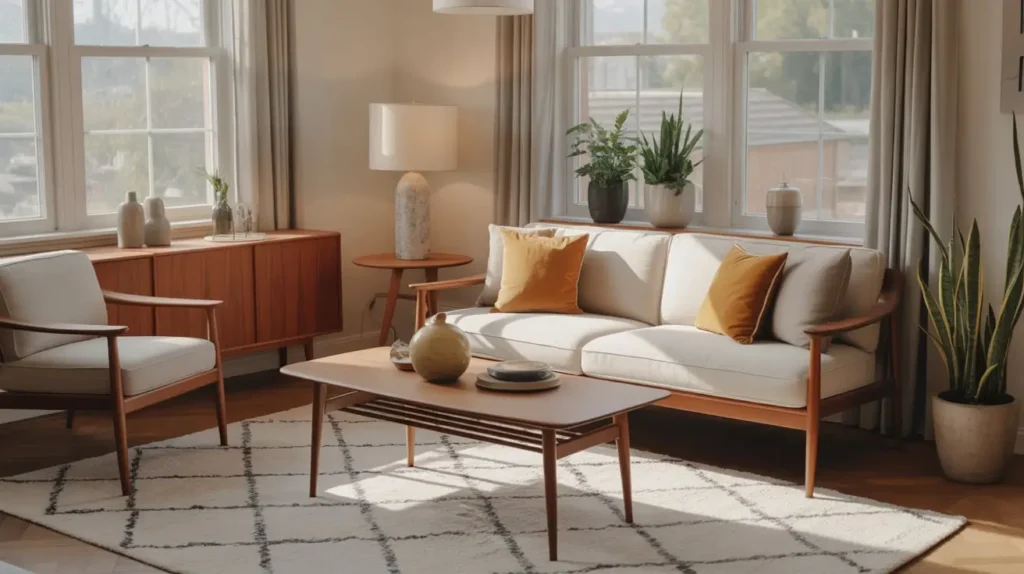
Nothing screams mid-century modern quite like warm wood tones filling up your space. I’m talking rich walnut, teak, and that gorgeous honey-colored oak that makes everything feel instantly cozier.
The beauty of a warm wood-focused living room lies in the layering of different wood tones. You don’t need to match everything perfectly—actually, please don’t. Mix your walnut coffee table with oak shelving and maybe throw in some teak side tables. The varied tones create depth and keep things interesting without looking like you bought everything from the same furniture set (which, let’s be honest, is kind of boring).
Your flooring sets the foundation here. Light to medium wood floors work beautifully, but if you’re stuck with carpet or something less ideal, a large area rug with warm undertones does the trick. I learned this the hard way after trying to make a cool-toned gray rug work—it just killed the whole vibe :/.
Key elements to nail this look:
- Low-profile wooden credenzas or sideboards
- Wood-framed sofas with tapered legs
- Floating shelves in warm wood tones
- Wood and upholstery armchairs
- Natural wood coffee table with organic shapes
Keep your walls neutral—white, cream, or warm beige lets the wood take center stage. And here’s a pro tip: real wood beats veneer every single time. Save up for quality pieces if you need to; they’ll last decades and actually age beautifully.
Minimalist Mid-Century Apartment Space
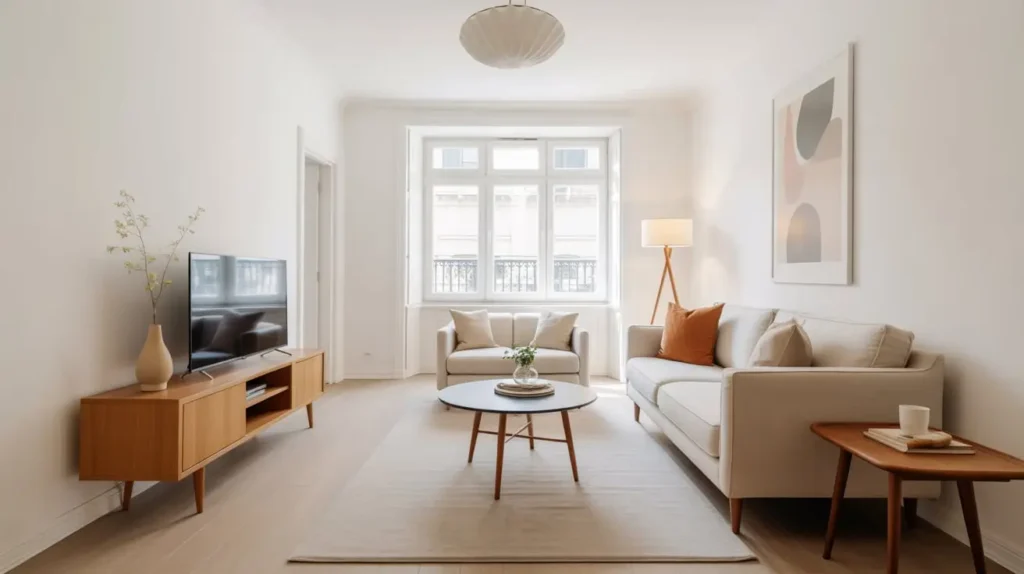
Ever walked into a space that feels both empty and complete at the same time? That’s minimalist mid-century design working its magic.
This approach strips everything down to the essentials, but unlike stark minimalism, it keeps things warm and inviting. You focus on quality over quantity—fewer pieces, but each one matters. Your couch becomes a statement. Your single accent chair pulls its weight. Even your coffee table earns its spot.
I tried this in my first apartment, and honestly, it was liberating. No clutter, no random decorative objects I felt obligated to dust, just clean lines and intentional choices. The key is selecting pieces with sculptural qualities that become art in themselves.
What you actually need:
- One stellar sofa (make it count)
- A signature lounge chair
- Minimal coffee table with interesting shape
- Floor lamp with architectural presence
- Maybe one credenza for storage
Color palette stays tight here. Stick to neutrals with maybe one accent color. Black and white photography on the walls works beautifully, or go with one large-scale abstract piece. The negative space isn’t emptiness—it’s intentional breathing room.
Window treatments should be simple. Think clean-lined curtains or even nothing at all if you’ve got the privacy for it. Every element you add should answer the question: “Does this serve a purpose or bring me joy?” If the answer is no, skip it.
Retro-Inspired Living Room with Bold Accents
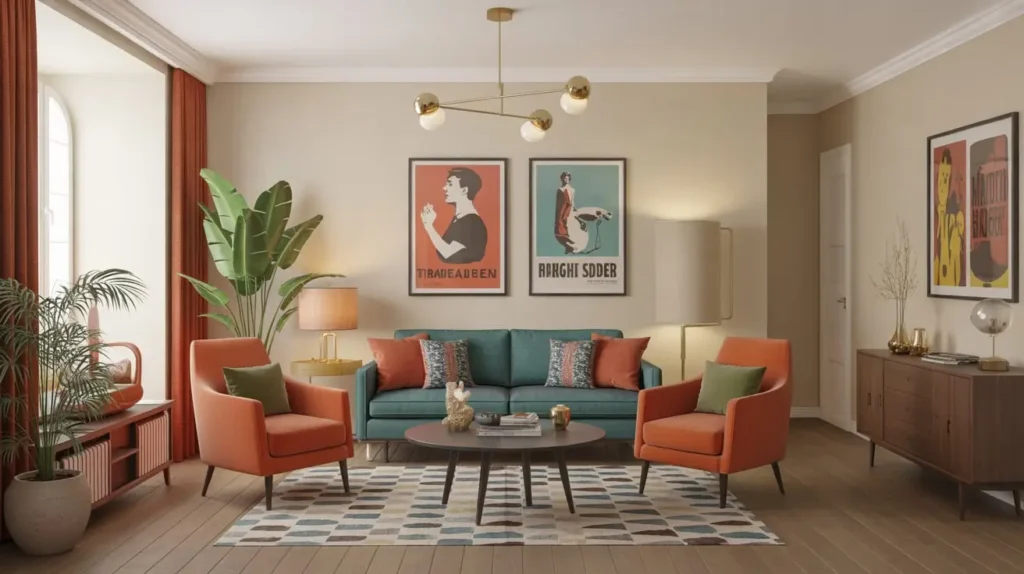
Want to have some actual fun with your living room? This is where you get to play.
Retro-inspired mid-century design lets you embrace those bold geometric patterns, vibrant accent colors, and playful accessories that make people smile when they walk in. I’m talking burnt orange throw pillows, teal accent chairs, and maybe even a sunburst clock (yes, they’re cheesy, but they’re our cheese).
The trick here is balance. You need that solid mid-century foundation—your classic furniture shapes, your clean lines—then you layer in the personality. Think of it like seasoning food. You don’t dump the entire spice cabinet in; you add just enough to make things interesting.
Bold elements that work:
- Geometric print pillows and throws
- Vibrant accent chairs in mustard, orange, or teal
- Retro-patterned area rug
- Vintage-style record player (functional and decorative)
- Bold abstract art with period-appropriate colors
- Bar cart styled with vintage glassware
Your wall color can be more adventurous here. A deep teal accent wall? Yes. Burnt orange behind your credenza? Absolutely. Just pick one wall and commit—don’t turn your living room into a color wheel demonstration.
I love mixing actual vintage finds with modern reproductions in this style. That authentic vintage lamp you scored at an estate sale brings character that new stuff just can’t fake. But FYI, not everything needs to be genuine vintage—good reproductions fill gaps without breaking the bank.
Mid-Century Modern Boho Fusion
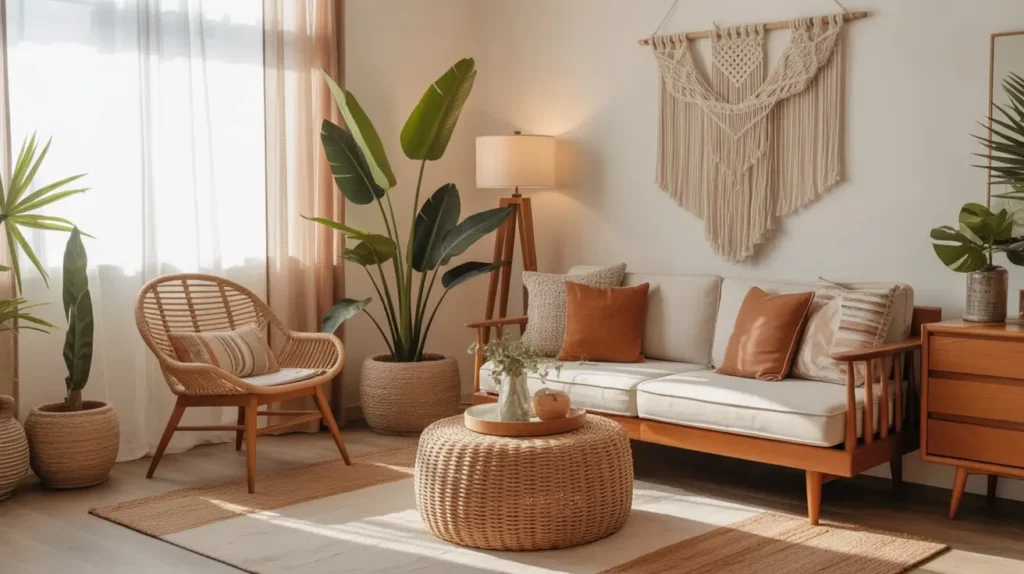
Okay, hear me out. I know mixing design styles can go sideways fast, but mid-century modern and boho actually share some DNA. Both celebrate natural materials, both love organic shapes, and both prioritize comfort.
The fusion creates warmth that straight mid-century sometimes lacks. You take those clean-lined mid-century pieces and soften them with textured throws, macramé wall hangings, and loads of plants. Suddenly your living room feels like a space actual humans live in, not a museum exhibit.
I stumbled into this style accidentally when I couldn’t bear to part with my vintage Moroccan rug after committing to mid-century furniture. Turns out? They loved each other. The rug’s geometric patterns played beautifully with my angular furniture.
Making this fusion work:
- Start with mid-century furniture as your base
- Layer in textured textiles (woven, macramé, chunky knits)
- Add rattan or wicker accent pieces
- Go plant crazy—hanging plants, floor plants, all the plants
- Mix in global-inspired accessories
- Use natural fiber rugs
Keep your color scheme earthy and connected. Terracotta, sage green, warm neutrals, and natural wood tones all play nicely together. The goal is collected-over-time vibes, not “I bought out HomeGoods in one trip.”
Lighting becomes super important here. String lights or a woven pendant fixture bridges both styles beautifully. And please, embrace the imperfection—a slightly worn leather chair or a vintage rug with character marks adds to the appeal.
Also Read: 15 Gorgeous Wall Decor Living Room Ideas on a Budget
Cozy Neutrals Mid-Century Lounge
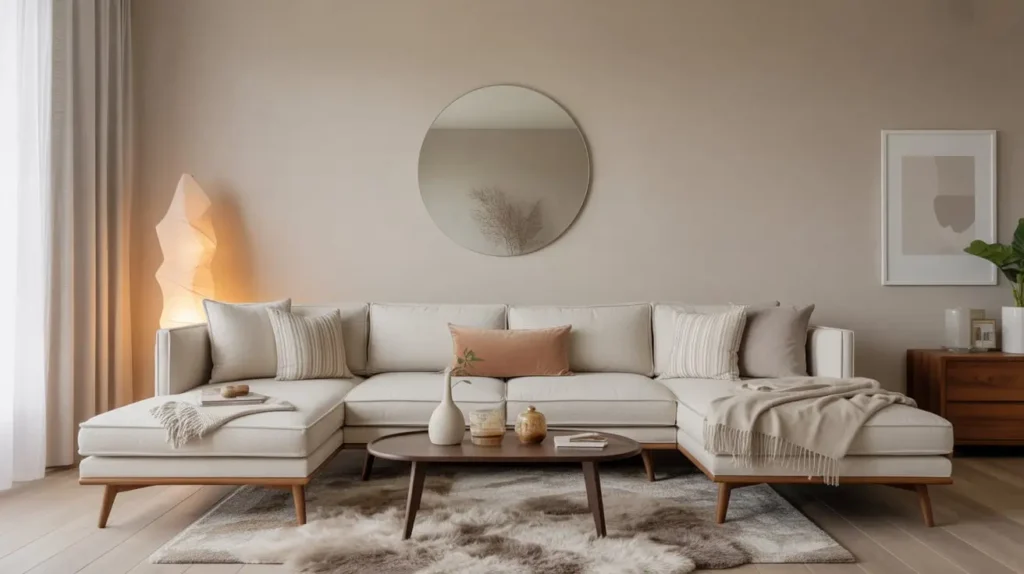
Sometimes you just want to come home and feel wrapped in a warm hug, you know? That’s what a cozy neutrals mid-century lounge delivers.
This approach leans into monochromatic magic—layers of cream, beige, taupe, warm gray, and soft browns. Before you roll your eyes thinking “boring,” trust me on this. The depth comes from varying textures and subtle tone shifts that create serious sophistication.
Your sofa might be oatmeal linen. Your armchair in camel leather. Your rug in creamy wool. The coffee table in light oak. Everything flows together while the different materials keep things visually interesting. I’ve had friends walk into my neutral living room and immediately relax—there’s something psychologically calming about it.
Building your neutral palette:
- Choose three to five neutral shades that work together
- Mix materials: leather, linen, wool, wood, metal
- Layer different textures for depth
- Use matte and glossy finishes
- Add warmth with wood tones
The furniture shapes stay true to mid-century principles—those tapered legs, those low profiles, those gentle curves. But the upholstery and finishes keep everything soft and approachable. Throw in nubby textured pillows, a chunky knit blanket, and maybe a sheepskin draped over your chair.
What saves this from feeling bland? Texture, texture, texture. A smooth leather sofa needs a rough woven rug. Sleek wood surfaces need soft fabric moments. Play with sheen too—matte walls with glossy ceramic accessories, for instance.
Vintage-Inspired Living Room Makeover
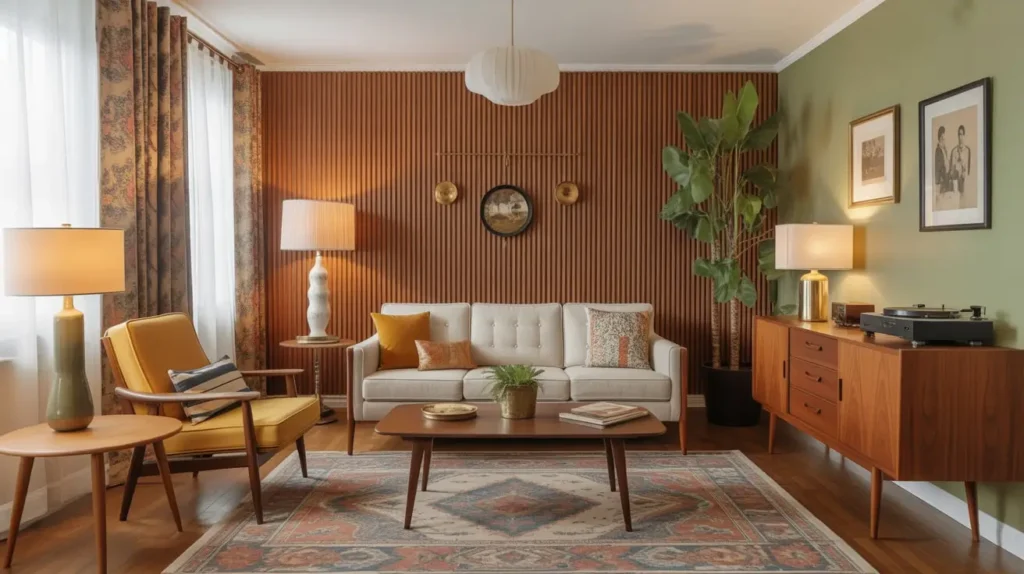
Want the real deal vintage vibe without actually time-traveling? A vintage-inspired makeover captures authentic mid-century charm while working with modern living requirements.
This means hunting for actual vintage pieces (or really convincing reproductions) and building a room that feels like it was designed in 1958, then lovingly maintained. I love this approach because it tells a story. Each piece has character, even if some of that character is strategic distressing on new furniture.
The authenticity matters here. You research what actual mid-century living rooms looked like. You study period-correct colors. You pay attention to the details like knowing that avocado green and harvest gold didn’t really dominate until the late 60s and early 70s.
Creating authentic vintage appeal:
- Source genuine vintage furniture when possible
- Choose period-correct colors (think warm neutrals, teals, burnt orange)
- Add vintage accessories (ashtrays, barware, ceramics)
- Hang vintage-style sunburst or atomic wall clocks
- Use reproduction wallpaper with period patterns
- Style shelves with vintage books and objects
I spent months haunting estate sales and vintage shops to furnish one room this way. Was it more work than ordering everything online? Absolutely. But was it worth it for the compliments and the stories behind each piece? Also absolutely.
The condition debate is real though. Some distressing adds character; too much just looks shabby. You want “well-loved” not “ready for the dump.” And honestly, reupholstering a killer vintage piece beats buying new mediocre stuff any day.
Scandinavian Meets Mid-Century Design
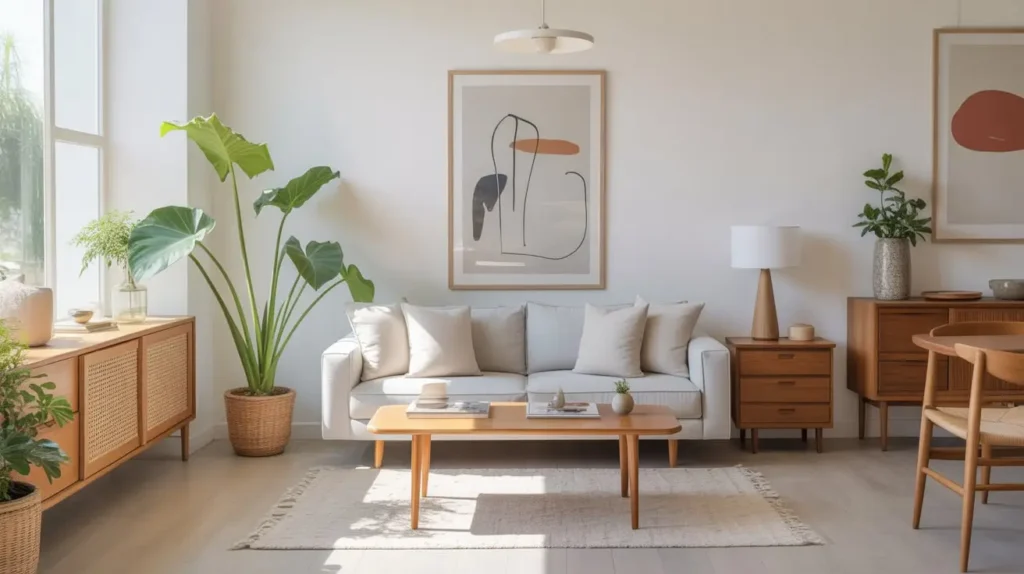
Plot twist: Scandinavian and mid-century modern design are basically cousins. Both emerged from similar design philosophies, both champion functionality, and both love clean lines and natural materials.
The Scandinavian influence brings even more lightness and simplicity. You lighten your wood tones, brighten your palette, and embrace that famous “hygge” coziness. The result feels airy, calm, and impossibly chic.
Your furniture stays low and streamlined, but you might lean toward lighter woods like birch, beech, or light oak instead of darker walnut. White walls become your best friend. Natural light flows freely—heavy drapes don’t exist here.
Scandi-MCM essentials:
- Light wood furniture with simple lines
- White or very light neutral walls
- Minimal window treatments
- Cozy textiles in muted colors
- Lots of natural light
- Strategic pops of black for contrast
- Sheepskin throws and natural fiber rugs
Texture creates warmth without adding visual clutter. A white bouclé sofa, a light wood coffee table, a soft wool rug, some linen curtains—all neutral, all interesting. Then you add life with plants (Scandinavians love their plants) and maybe some black metal accents for definition.
I borrowed heavily from this style for a small living room that lacked natural light. The light-on-light approach actually made the space feel bigger and brighter. IMO, this works especially well in smaller homes or apartments where you need every trick to maximize the sense of space.
Mid-Century Glam Living Room Style
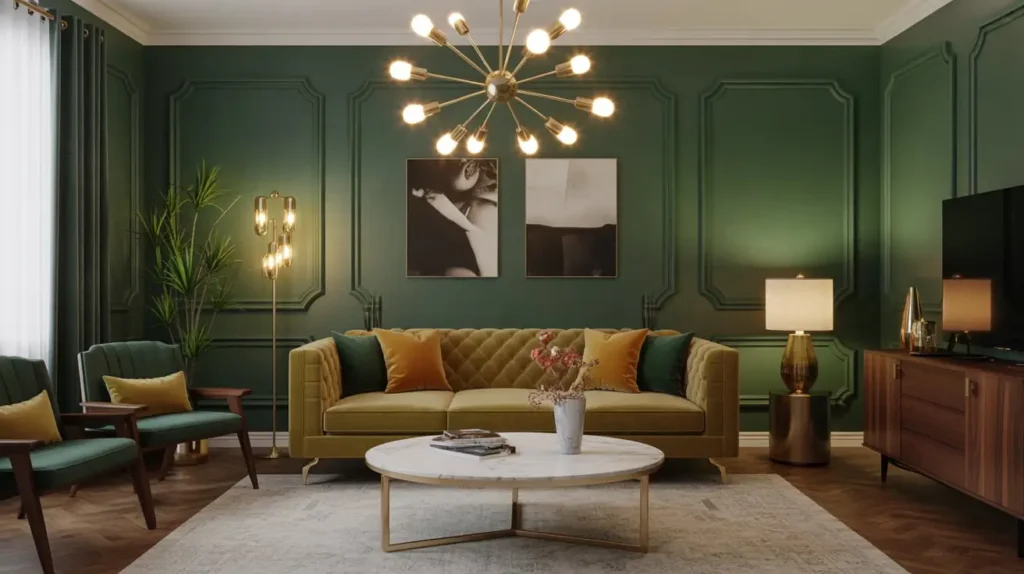
Who says mid-century has to be understated? Sometimes you want your living room to have a little sparkle, a little drama, a touch of “yes, I am fancy, thanks for noticing.”
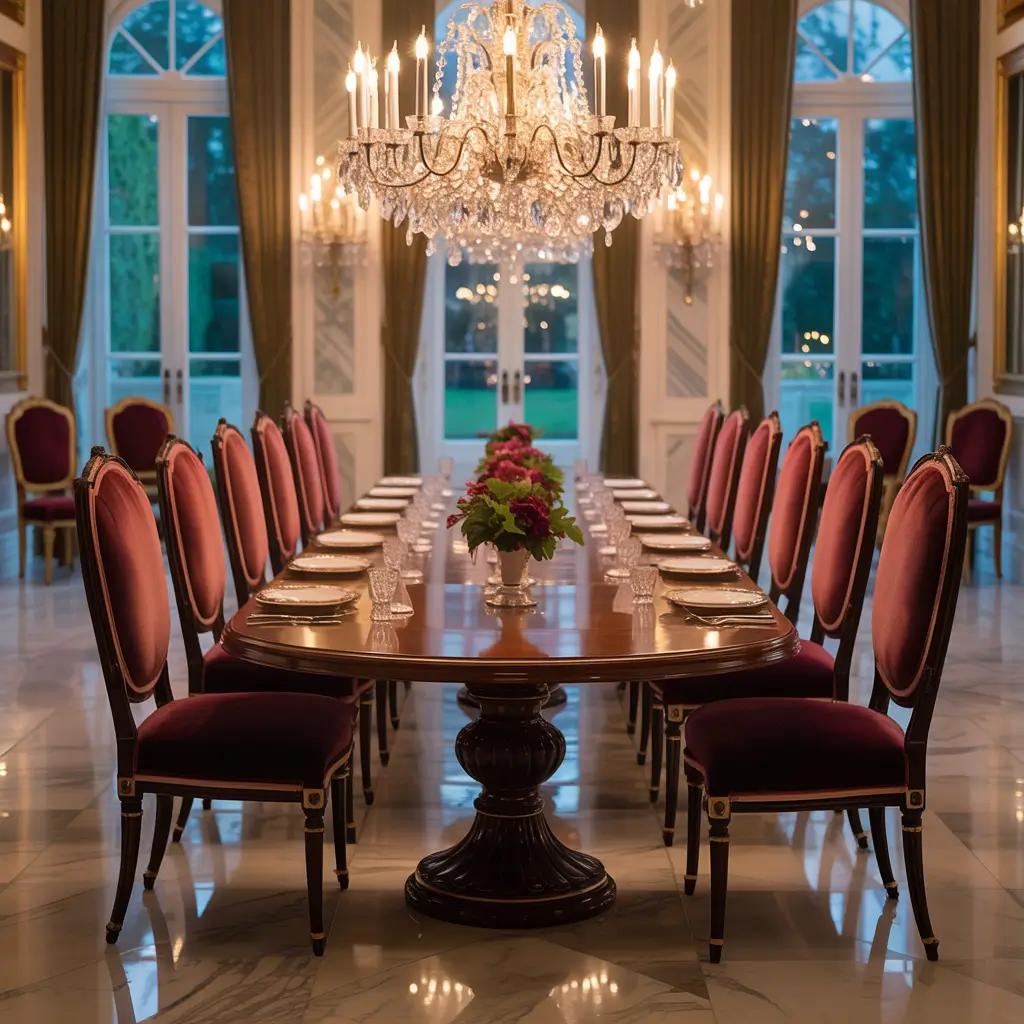
Mid-century glam marries those classic silhouettes with luxe materials and elevated finishes. Your coffee table might have brass legs instead of wood. Your lighting fixtures feature crystal or glass. Your textiles lean velvet instead of linen. Suddenly, Don Draper’s office meets Hollywood Regency.
The balance is crucial here. Too much glam and you’ve left mid-century behind entirely. Too little and you’re just doing regular mid-century with shiny knobs. You need those clean lines and functional forms, but executed in premium materials with that extra polish.
Glam MCM elements:
- Velvet upholstery in jewel tones
- Brass or gold metal accents
- Marble or glass table tops
- Crystal or sculptural glass lighting
- Mirrored or lacquered surfaces
- Plush area rugs
- Statement art in ornate frames
Color-wise, you can go rich. Emerald green velvet sofa? Perfect. Navy blue with brass details? Gorgeous. Keep the overall palette cohesive, but don’t shy away from saturated colors that make a statement.
I added glam touches to my living room gradually, swapping out wood legs for brass on my coffee table and upgrading to a velvet accent chair. Small changes created big impact without requiring a complete overhaul. Sometimes it’s the details—fancy drawer pulls, a lucite table, metallic picture frames—that elevate the whole space.
Earth-Toned Mid-Century Retreat
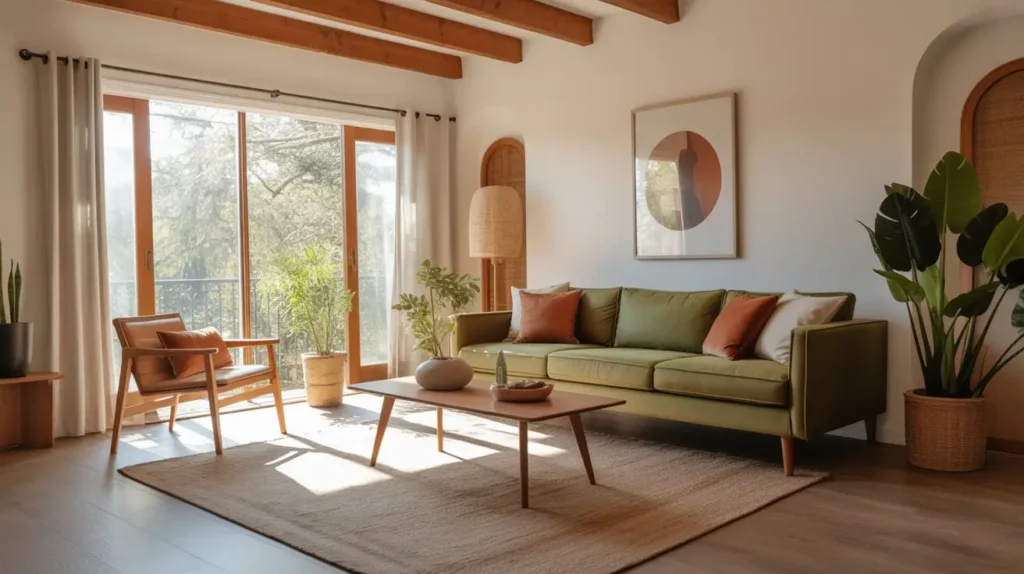
Creating a living room that feels like a retreat from the chaos of modern life? Earth tones deliver that grounded, peaceful energy you’re after.
This palette pulls from nature—terracotta, sage, clay, rust, ochre, warm browns, soft greens. These colors have been having a major moment lately, and for good reason. They’re warm without being aggressive, interesting without being loud, and they make spaces feel instantly calming.
Your mid-century furniture shapes provide the structure, but the earthy color story creates the mood. A rust-colored sofa anchors the room. Sage green pillows add freshness. Clay-colored ceramics on your credenza bring in organic shapes. Everything feels connected to the natural world.
Earth-tone essentials:
- Warm-toned upholstery (rust, terracotta, camel)
- Natural wood in medium to dark tones
- Clay, ceramic, and pottery accessories
- Muted green accents (sage, olive, moss)
- Natural fiber textiles and rugs
- Warm metal accents (brass, copper, bronze)
Plants become even more important in this scheme. They’re not just accessories—they’re part of the color story. A fiddle leaf fig in the corner, a snake plant on the credenza, hanging pothos trailing down your bookshelf—all these add those organic greens that complete the earthy palette.
I fully committed to earth tones in my living room last year and honestly? My stress levels dropped. There’s something about being surrounded by these colors that just feels right. Maybe it’s the biophilic design thing, or maybe these shades just don’t assault your eyeballs like neon accent walls :).
Compact Mid-Century Small Space Layout
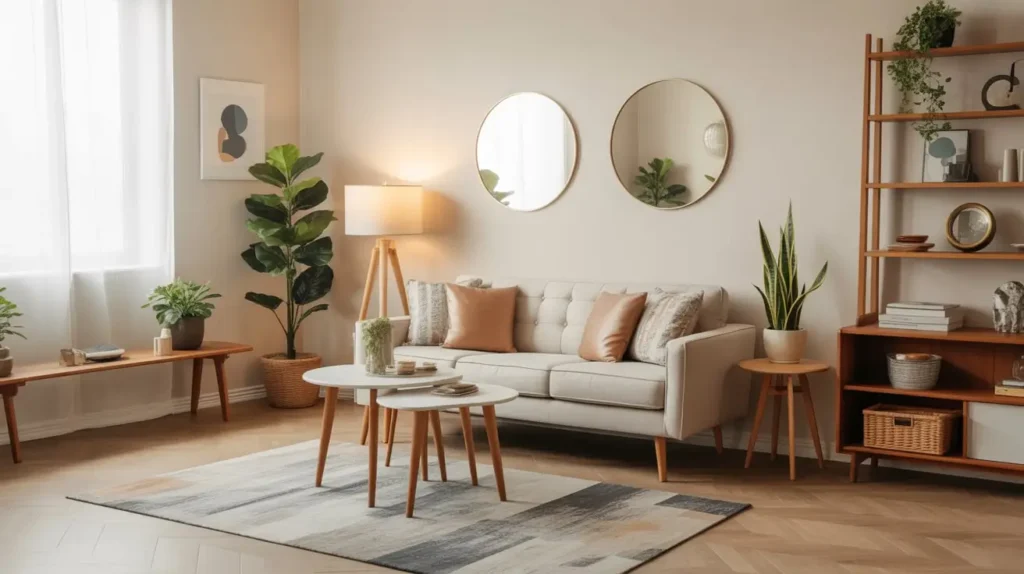
Small living room? Join the club. Most of us aren’t working with Don Draper’s office square footage, and that’s okay. Mid-century design actually excels in smaller spaces because of its emphasis on clean lines and multifunctional furniture.
The smartest thing you can do is embrace pieces designed for their visual lightness. Furniture on legs (rather than skirted pieces that sit directly on the floor) creates the illusion of more space because you can see through to the floor beyond. Those signature mid-century tapered legs aren’t just pretty—they’re practical.
Scale matters enormously here. A massive sectional overwhelms a small room, but a compact loveseat with a clean silhouette leaves breathing room. You need every piece to earn its spot through both function and form.
Small space MCM strategies:
- Choose furniture with exposed legs
- Use wall-mounted shelving instead of bookcases
- Pick a compact loveseat over a full sofa
- Select nesting tables for flexibility
- Mount your TV instead of using a media console
- Use vertical space for storage
- Keep the color palette light and cohesive
Multi-functional furniture becomes your best friend. That credenza provides storage while looking gorgeous. That coffee table maybe has a lift-top for working from home. That ottoman offers both seating and storage inside.
I lived in a 450-square-foot studio for two years and made mid-century work through ruthless editing. Every piece had to pull double duty. The result felt spacious and intentional instead of cramped and cluttered. Sometimes limitations force better design choices, honestly.
Also Read: 15 Cozy Living and Dining Room Combo Ideas with Warm Vibes
Mid-Century Living Room with Statement Lighting
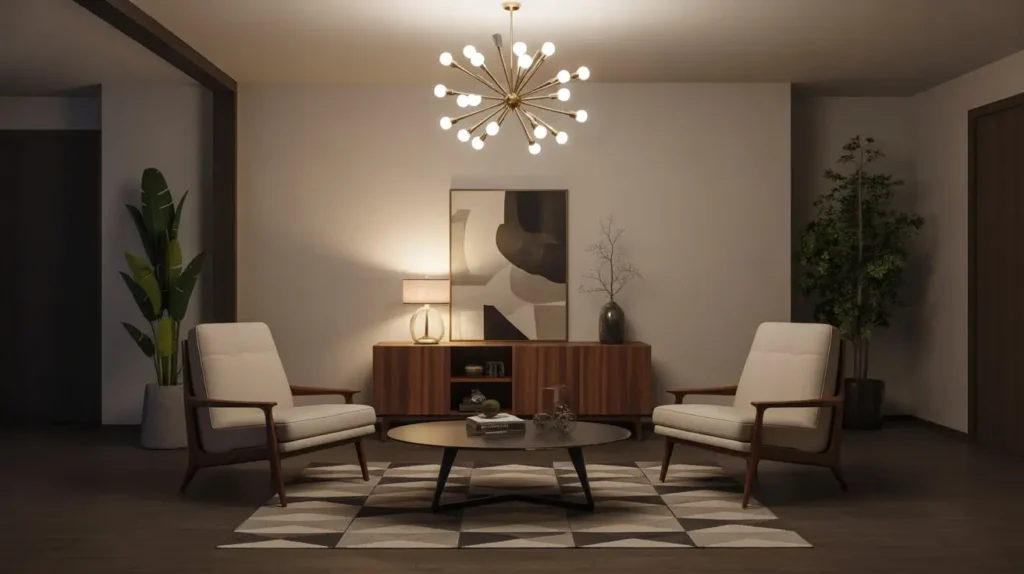
Let’s talk about the secret weapon of mid-century design: lighting that doubles as sculpture. We’re not just illuminating the room; we’re creating focal points and adding serious design impact.
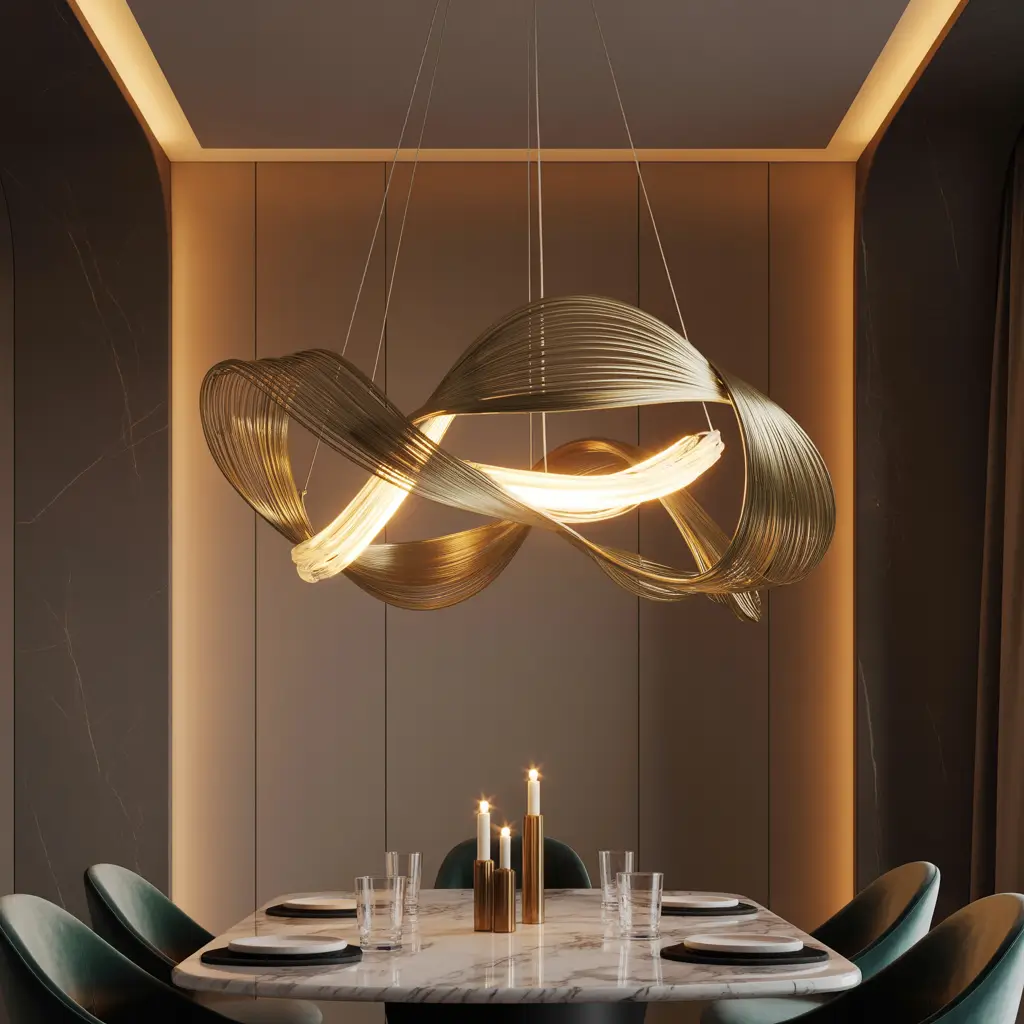
Mid-century lighting designers went wild with innovation. Sputnik chandeliers, arc floor lamps, tripod table lamps, geometric pendants—these aren’t mere light sources; they’re conversation pieces. And honestly, good lighting can elevate even mediocre furniture.
The iconic arc floor lamp might be the single best investment for a mid-century living room. It provides overhead lighting without requiring ceiling installation, it creates a stunning visual moment, and it defines your seating area beautifully. Plus, you can move it around, which you definitely can’t do with a chandelier.
Statement lighting options:
- Sputnik or atomic-inspired chandeliers
- Arc floor lamps (brass, chrome, or matte black)
- Tripod floor or table lamps
- Nelson bubble lamps or similar organic shapes
- Geometric pendant fixtures
- Sculptural task lighting
Layering your lighting creates depth and functionality. Your statement piece provides drama, but you need ambient lighting from other sources too. Table lamps on your credenza, maybe a picture light highlighting your art, definitely some dimmer switches so you can adjust the mood.
I installed a brass arc lamp in my living room, and it completely transformed the space. Everyone who visits comments on it. It anchors the entire seating area and provides perfect reading light without overhead glare. Worth every penny of the investment—and I do mean every penny because these fixtures aren’t cheap.
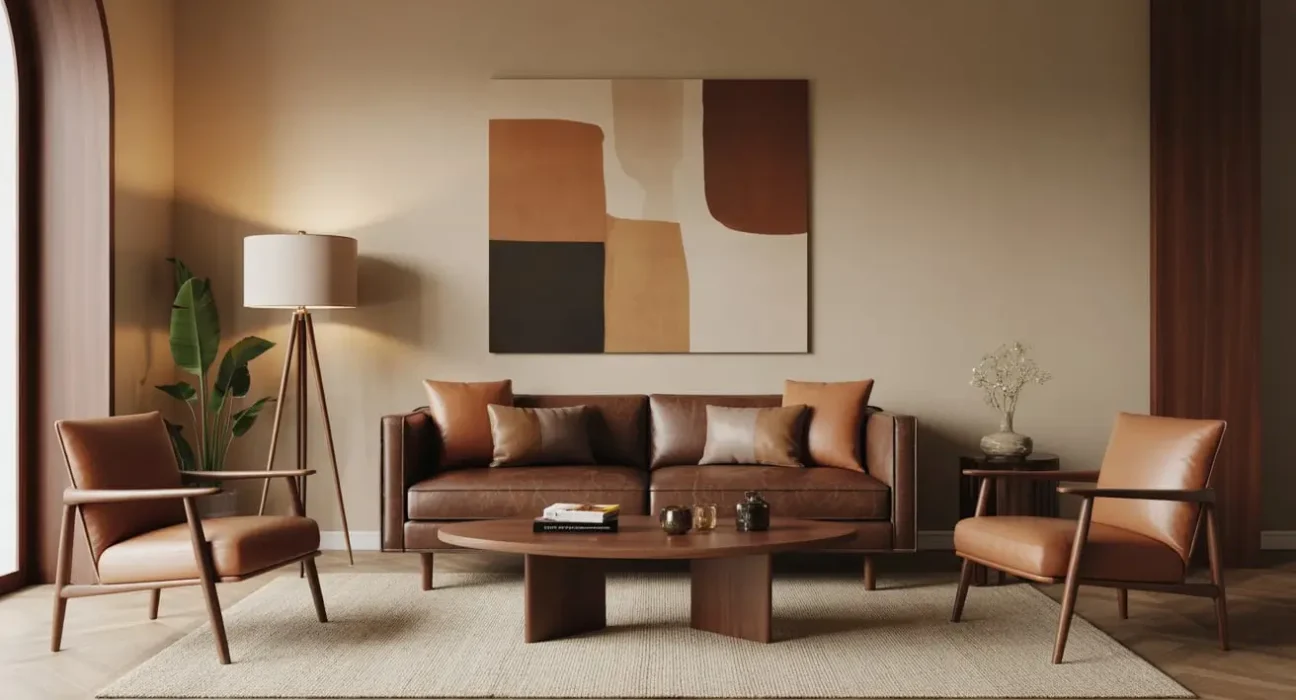
Walnut and Leather Mid-Century Interior
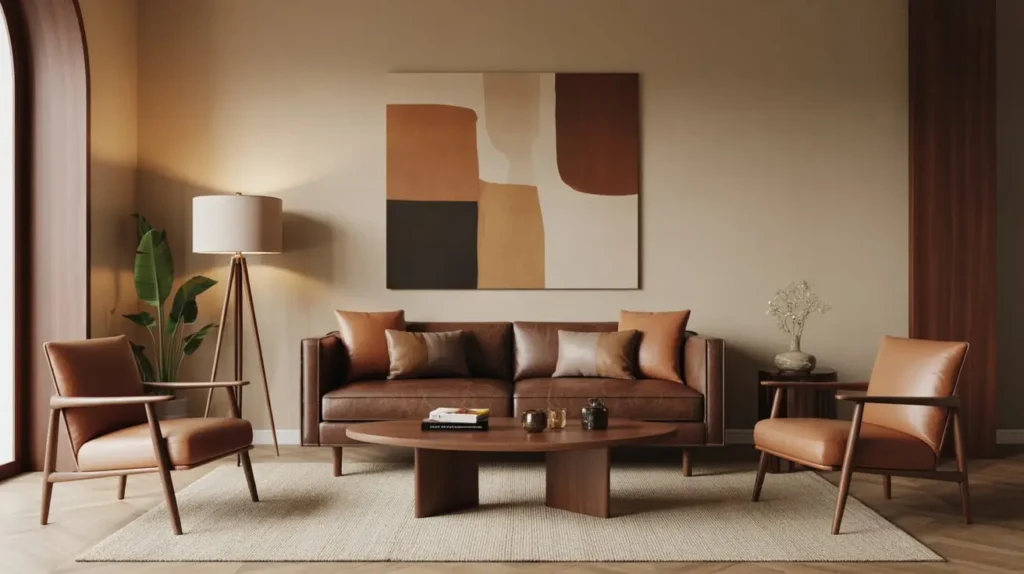
Want to know the combination that screams “classic mid-century” louder than anything else? Rich walnut wood paired with warm leather upholstery. It’s the peanut butter and jelly of design—each good on its own, spectacular together.
There’s something timelessly masculine and sophisticated about this pairing. The deep brown tones of walnut provide warmth and richness. The leather adds texture and patina that actually improves with age. Together, they create spaces that feel both polished and comfortable.
Your focal point might be a cognac leather sofa with walnut legs and trim. Or maybe a walnut credenza flanked by leather lounge chairs. The wood and leather conversation happens throughout the room, creating cohesion through material repetition.
Walnut and leather elements:
- Leather sofa or lounge chairs (cognac, tan, or chocolate)
- Walnut coffee table, credenza, or side tables
- Leather and walnut dining chairs if your space is open concept
- Walnut-framed mirrors or art
- Leather-topped desk if you have a work area
- Walnut shelving units
The rest of your palette should support these stars without competing. Neutral walls, simple window treatments, and accessories that complement rather than distract. Maybe some brass accents to play with the warm tones. Plants to add freshness. Abstract art with warm undertones.
One thing I learned the hard way: not all brown leather works with walnut. Reddish-brown leather clashes, while camel or cognac tones harmonize beautifully. Bring wood samples when you’re shopping for leather furniture—seriously, it saves heartache later.
Open Concept Mid-Century Living Area
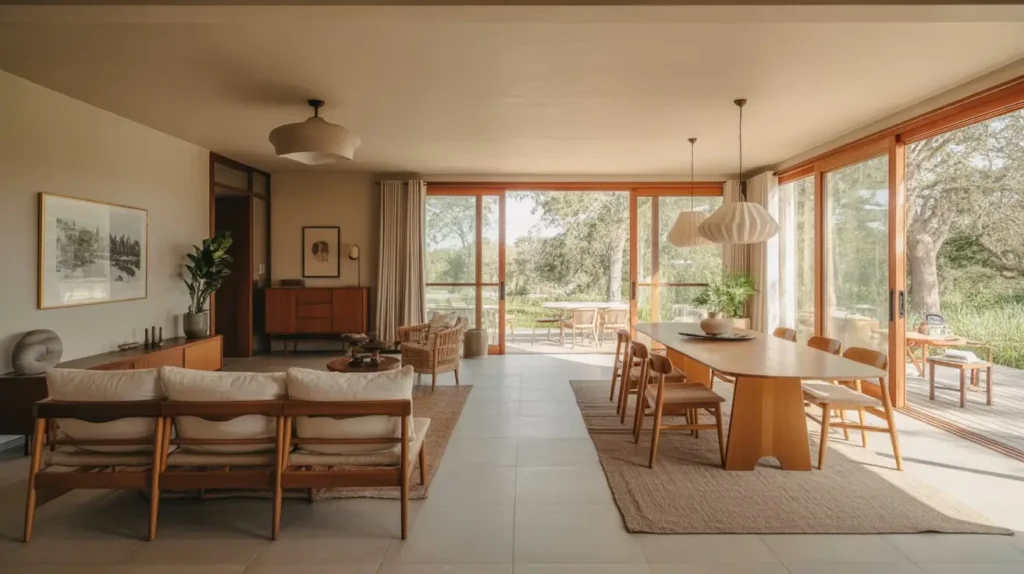
Open concept layouts present unique challenges and opportunities for mid-century design. You’re defining spaces without walls, creating flow while maintaining distinct zones, and making everything feel cohesive across a large area.
Furniture placement becomes crucial when you don’t have walls to work with. Your sofa might float in the middle of the room, creating the living area boundary. Your credenza might serve as a divider between living and dining spaces. Every piece helps define the room’s purpose and flow.
The beauty of mid-century design in open concepts is the style’s inherent emphasis on clean sightlines. Those low-profile furniture pieces don’t block views. The minimal approach prevents visual clutter that can overwhelm large spaces. Everything feels intentional and flowing.
Open concept MCM strategies:
- Use area rugs to define different zones
- Create conversation areas with furniture arrangement
- Maintain consistent style throughout
- Vary lighting to distinguish spaces
- Use credenzas or bookcases as subtle dividers
- Keep color palette cohesive across the whole area
- Ensure sightlines remain clean
Consistency matters more in open layouts. You don’t need to match everything, but your furniture should feel like it belongs to the same family. All walnut wood pieces, perhaps, or a consistent metal finish across different zones. The eye should travel smoothly from space to space without jarring transitions.
I redesigned my open concept living/dining area last year, and the biggest challenge was creating intimacy within the openness. The trick was using the furniture arrangement to create a cozy conversation area without blocking off the space. The low-slung sofa and chairs allowed visual flow while defining the zone clearly.
Color Pop Mid-Century Decor Style
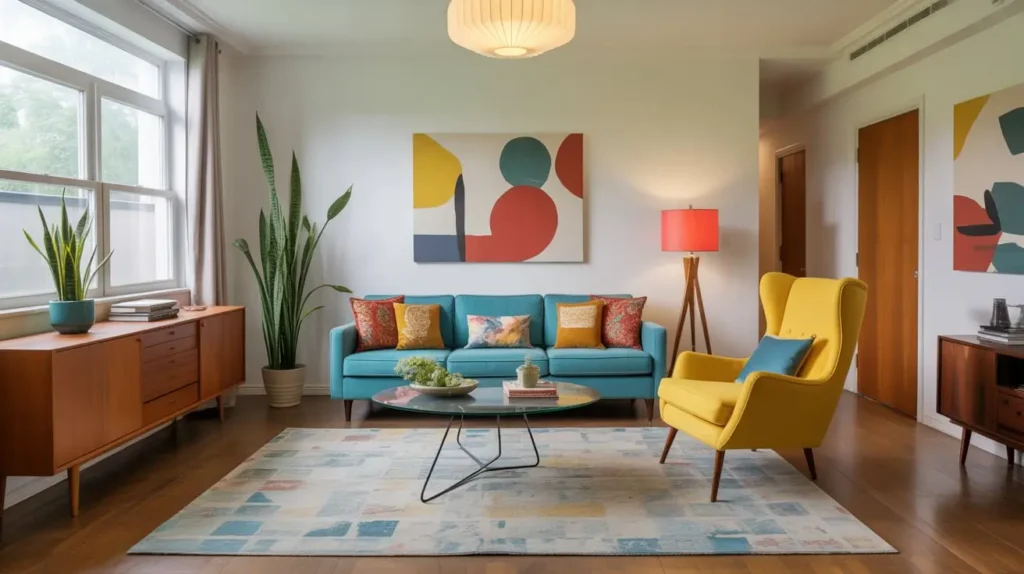
Ready to have some fun? Color pop mid-century throws the neutral rulebook out the window and embraces bold, saturated accent colors that make your living room impossible to ignore.
The approach is simple: establish a neutral foundation, then inject strategic pops of vibrant color that energize the space. Your walls stay white or neutral. Your major furniture pieces might be neutral too. Then BAM—a cherry red accent chair. POW—a cobalt blue credenza. WHAM—abstract art with all the colors.
The trick is being intentional rather than random. Pick two or three bold colors and repeat them throughout the space. Your accent chair, some pillows, artwork, maybe a throw—they echo each other, creating deliberate design rather than chaos.
Color pop elements:
- Bold accent chairs (red, yellow, blue, green)
- Painted credenzas or cabinets in saturated hues
- Colorful pillows and throws
- Vibrant abstract artwork
- Bright ceramics and accessories
- Colored glassware displays
- Statement rugs with bold patterns
I went with a teal accent chair and coral accessories in my otherwise neutral living room, and the transformation was instant. The space went from sophisticated but maybe a little boring to dynamic and personal. Those color pops reflect my personality in ways that all-neutral couldn’t.
Don’t be afraid to go bold with your choices. That chartreuse chair you’re nervous about? If you love it, commit. The worst-case scenario is you reupholster it later, and the best case is it becomes your favorite piece in the house.
Mid-Century Living Room with Modern Art Touches
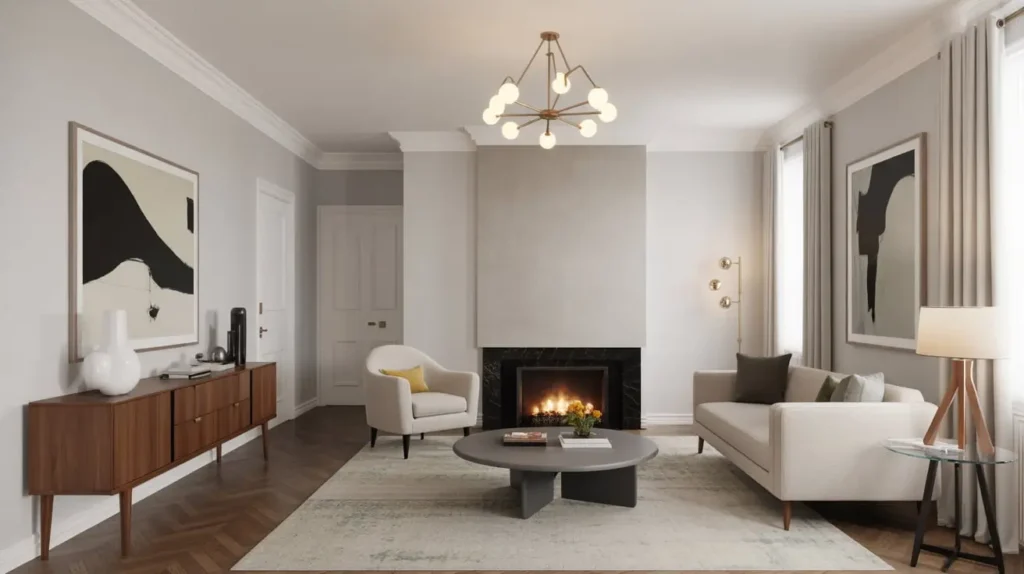
Last but definitely not least, let’s talk about combining mid-century design with contemporary art for a living room that feels collected, cultured, and decidedly now.
Mid-century furniture provides such a clean, uncluttered backdrop that it practically begs for interesting art. The simple lines don’t compete with complex artwork—they complement it. Your living room becomes a gallery where the furniture and art have an ongoing conversation.
The scale of your art matters enormously. One large statement piece creates more impact than a cluttered gallery wall. Think big canvas, bold colors, interesting composition. Or go with a series of three to five pieces in similar frames for a curated feel.
Modern art integration:
- Large-scale abstract paintings or prints
- Black and white photography in simple frames
- Sculptural art pieces on credenzas or shelves
- Art ledges for rotating displays
- Mixed media pieces with texture
- Contemporary sculptures on side tables
- Gallery-style lighting to highlight key pieces
Color coordination helps art and space work together. Pull accent colors from your artwork into pillows or accessories. Or go the opposite direction—keep the room neutral and let the art provide all the color drama.
I started collecting affordable prints from local artists and rotating them seasonally. My mid-century living room stays fresh without requiring furniture changes. The clean furniture backdrop makes even simple art look more important and intentional.
Framing quality matters more than you’d think. A beautiful print in a cheap frame looks cheap. That same print in a substantial frame with quality matting looks like investment art. Hit up estate sales for vintage frames—they’re affordable and add character.
Wrapping This Up
Look, mid-century modern living rooms work because they nail the fundamentals—function, form, and that elusive quality of timelessness. Whether you’re drawn to warm woods, bold colors, minimalist spaces, or glammed-up glamour, there’s a mid-century approach that fits your style.
The best part? You don’t need to commit to just one of these ideas. Mix the earth tones with statement lighting. Combine the Scandinavian influence with modern art. Layer the walnut and leather with some boho plants. Your living room should reflect your personality, not follow some rigid design rulebook.
Start with one or two ideas that really speak to you, then build from there. Hunt for that perfect vintage credenza. Save up for a quality leather sofa that’ll last decades. Gradually add those thoughtful touches that transform a room from “furniture in a space” to “living room with soul.”
And remember, mid-century modern isn’t about recreating 1958 exactly—it’s about capturing what made that era’s design so compelling and making it work for how you actually live today. Your smartphone charging station can totally coexist with your teak sideboard. You can watch Netflix on a modern TV mounted above your vintage credenza.
Now get out there and create a living room you’ll actually love living in. Your tapered-leg furniture journey starts now, and honestly? You’re going to love where it takes you.