

15 Creative Small Space Living Room Ideas for Modern Homes
The Small Living Room Struggle is Real
Look, I get it. You’re staring at your cramped living room, wondering how on earth you’re supposed to fit a sofa, coffee table, and maybe—just maybe—a decent entertainment setup without turning the place into an obstacle course. Been there, done that, got the bruised shins to prove it.
Small living rooms don’t have to feel like shoebox prisons. I’ve lived in more tiny apartments than I care to admit, and trust me, I’ve learned a thing or two about making limited square footage work harder than it has any right to. The secret? Smart design choices that trick the eye and maximize every single inch.
Ready to transform your compact living room from “I can barely breathe” to “Wait, this place actually feels spacious”? Let’s talk about 15 game-changing ideas that actually work in real life—not just in those Pinterest photos that make you feel inadequate.
Floating Shelves with Hidden Storage
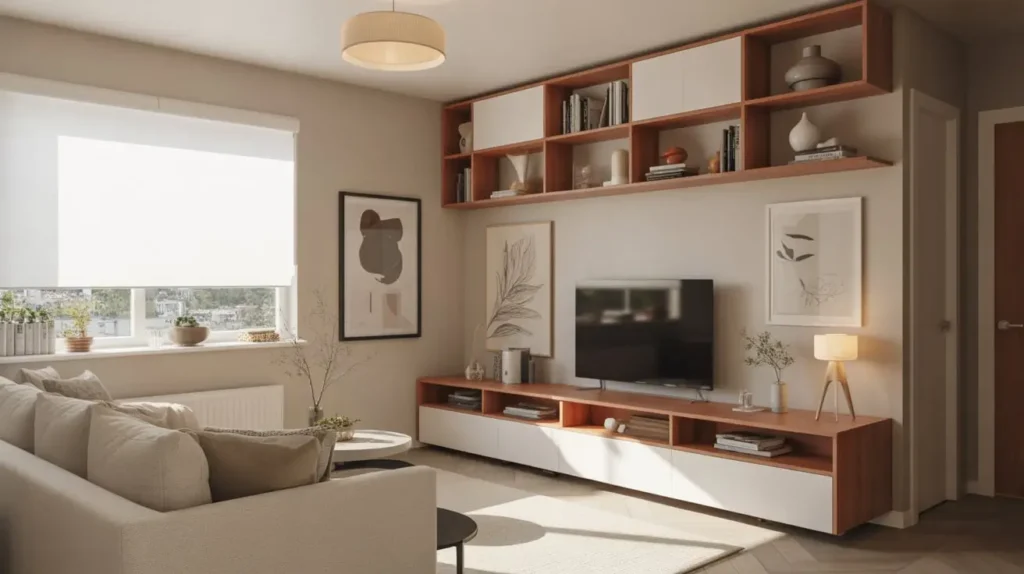
Here’s the thing about traditional bulky shelving units: they eat up floor space like nobody’s business. Floating shelves completely change the game by giving you storage and display space without that visual heaviness.
I installed floating shelves in my last apartment, and honestly? Best decision ever. You mount them directly to the wall, which means zero footprint on your precious floor space. But here’s where it gets clever—many floating shelf designs now come with hidden storage compartments built right in.
Why This Works So Well
The hidden storage aspect means you can stash away remotes, charging cables, coasters, and all those random bits that usually clutter up your coffee table. From the outside, people just see your carefully curated book collection or those succulents you’re somehow keeping alive.
Pro tip from personal experience: Install these shelves at varying heights to create visual interest. Don’t just line them up like boring soldiers. Stagger them, play with the arrangement, and suddenly your wall becomes this dynamic focal point instead of dead space.
Foldable Coffee Table Design
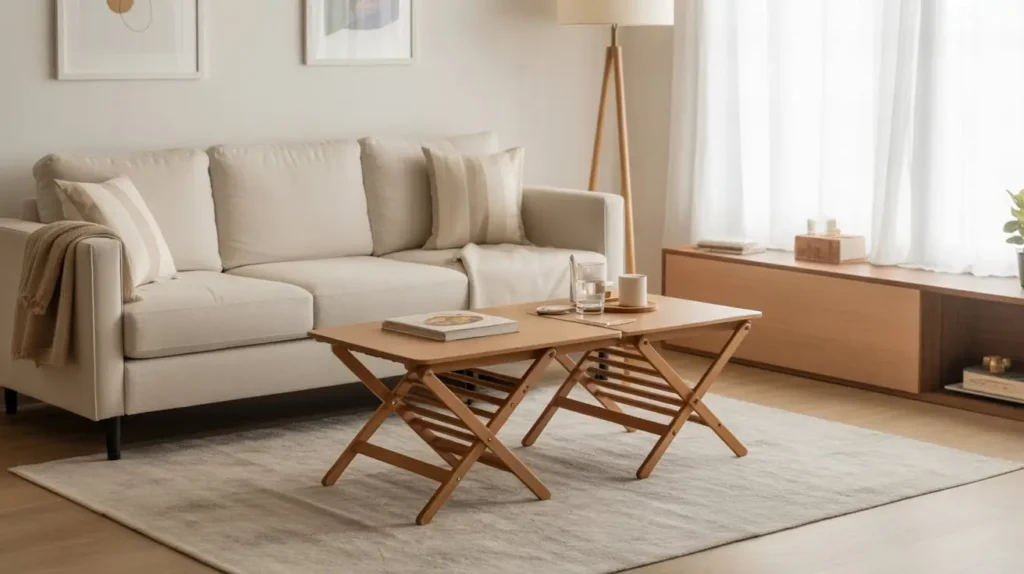
Ever wish your coffee table could just… disappear when you need floor space for yoga or having friends over? Foldable coffee tables are the answer you didn’t know you needed.
I was skeptical at first—I mean, how sturdy could a folding table really be? Turns out, pretty darn sturdy when you invest in quality designs. Modern foldable coffee tables come in sleek styles that don’t scream “temporary furniture,” and they give you incredible flexibility.
The Practical Magic
You can fold them down when you’re hosting a movie night and need to squeeze extra floor cushions in, or collapse them completely when you’re doing that workout video you promised yourself you’d actually do. When you need a proper surface for your coffee (or wine, no judgment), boom—full table mode activated.
Look for designs with locking mechanisms that keep the table stable when it’s up. Nothing ruins a relaxing evening like a wobbly surface spilling your drink. FYI, some models even have adjustable heights, so you can use them as a desk or dining surface when needed. Talk about multi-tasking furniture!
Light-Reflecting Mirror Wall
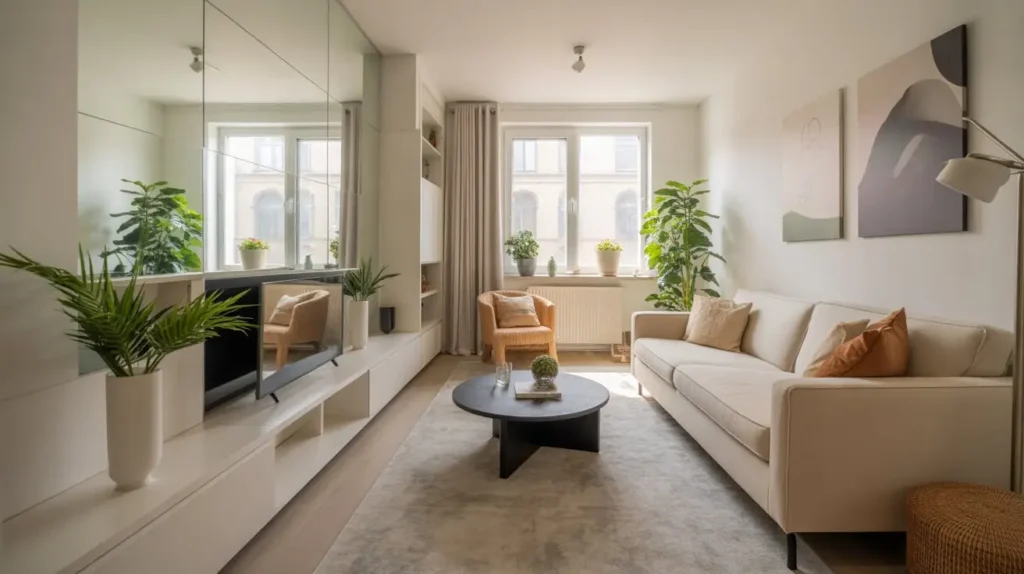
Want to know the oldest trick in the interior design book? Mirrors make spaces feel bigger. But we’re not talking about hanging one sad mirror and calling it a day.
A light-reflecting mirror wall creates the illusion of depth that honestly borders on magic. I set up a large mirror (we’re talking floor-to-ceiling vibes) opposite my window, and suddenly my living room looked twice its actual size. The natural light bounced around the room, making everything brighter and more open.
Strategic Mirror Placement
Here’s what you need to know: placement matters more than size. Position your mirror to reflect the most appealing view in your room—whether that’s a window, a piece of art, or your prettiest wall. Don’t aim it at cluttered areas, because then you’re just doubling the visual chaos.
You can go with one large statement mirror or create a gallery wall of smaller mirrors in different shapes. Both approaches work, but the larger mirror delivers more dramatic spatial impact. Bonus: you get a full-length mirror for checking your outfit before heading out. Practical AND space-enhancing? Sign me up.
Compact Sectional Sofa Setup
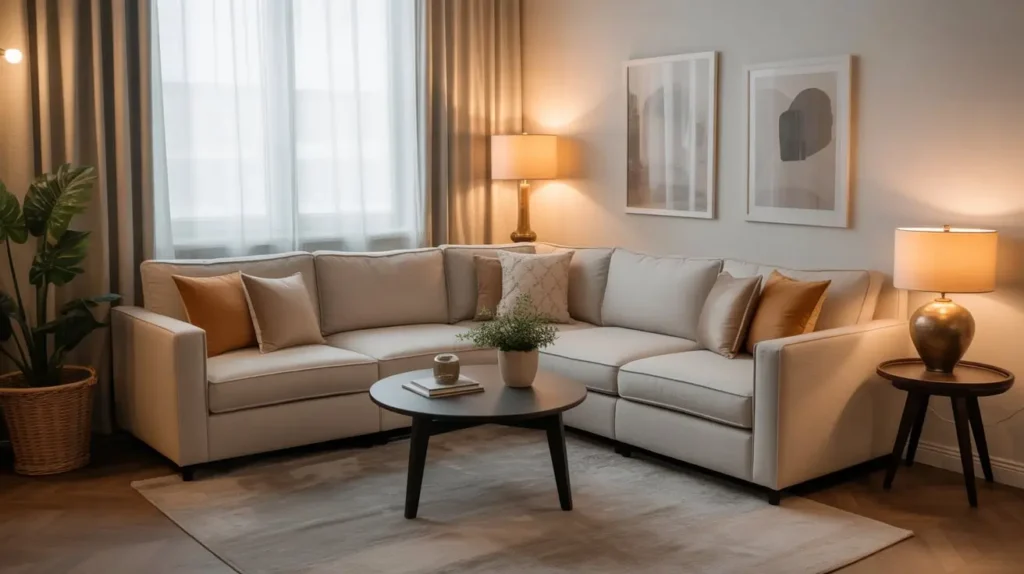
Someone finally figured out that sectionals don’t have to be massive room-dominators. Compact sectional sofas give you that cozy, wrap-around seating without swallowing your entire living room.
The key here is proportion. A regular sectional in a small space looks like you’re trying to fit a whale into a bathtub—awkward for everyone involved. But a properly scaled compact sectional? Chef’s kiss. It defines your seating area, provides plenty of spots for people, and can actually make a small room feel more intentional.
Choosing the Right Configuration
I spent way too much time researching this (my browser history was embarrassing), but here’s what matters:
- L-shaped configurations work better than U-shaped in tight spaces
- Low-profile designs with exposed legs create visual breathing room underneath
- Neutral colors prevent the sofa from overwhelming the space visually
- Reversible chaise options let you reconfigure based on your layout
Corner placement is your friend here. Tuck that sectional into a corner, and you’ve suddenly got a defined seating zone that doesn’t block traffic flow. Plus, everyone loves a corner seat—it’s just science.
Corner-Mounted TV Arrangement
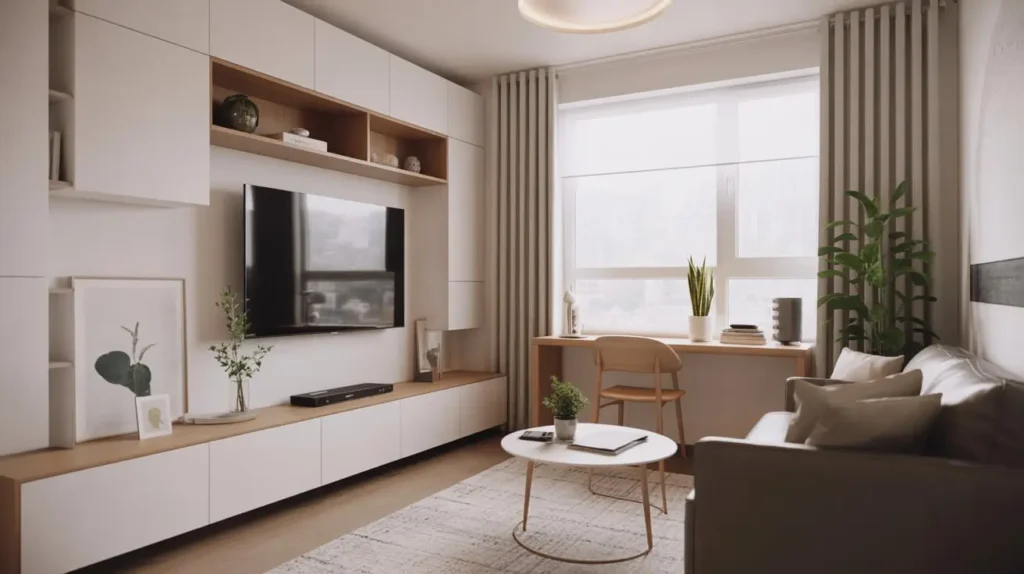
Why waste prime wall real estate when corners exist? Corner-mounted TV arrangements are criminally underused, and I’ll never understand why.
Most people automatically slap their TV on the longest wall, but that’s not always the smartest move in a small living room. Mounting your TV in a corner opens up wall space for other things (like those floating shelves we talked about) and can actually improve your room’s flow.
Making Corner Mounting Work
You’ll need a swivel mount—non-negotiable. This lets you angle the TV toward wherever you’re sitting, whether that’s your sofa or dining area. I’ve got mine set up this way, and I can watch Netflix from basically anywhere in my apartment. Living the dream over here 🙂
Consider adding a small corner shelf unit below the TV for your streaming devices and gaming consoles. This keeps everything contained in one zone and prevents cable chaos from spreading across your room. Organized cables equal a cleaner visual space, which your brain interprets as more room. Weird but true.
Also Read: 15 Trendy Very Small Living Room Ideas for 2025 Homes
Multi-Functional Ottoman Seating
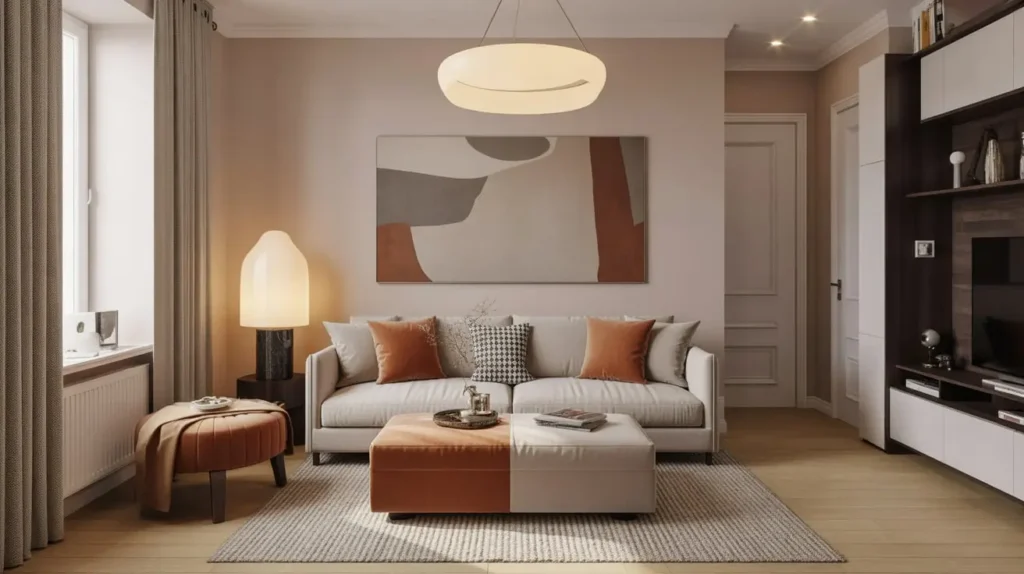
Ottomans are the unsung heroes of small space living. Seriously, why doesn’t everyone talk about these more? A multi-functional ottoman can be a footrest, extra seating, a coffee table, AND storage. That’s four jobs from one piece of furniture.
I have this storage ottoman that’s saved my life more times than I can count. When friends visit, it becomes extra seating. When I’m binge-watching alone (the usual scenario, let’s be honest), it’s a footrest. I store extra blankets and pillows inside, and when I plop a tray on top, it’s a perfectly functional coffee table.
Ottoman Selection Strategy
Look for ottomans with:
- Removable lids for easy access to storage
- Firm cushioning that supports weight when used as seating
- Neutral upholstery that matches multiple uses
- Lightweight design for easy repositioning
The mobility factor matters more than you’d think. Being able to scoot your ottoman around the room as needed gives you layout flexibility that fixed furniture just can’t match. Some days it’s coffee table duty, other days it’s pulled up as extra seating. Versatility for the win.
Minimalist Neutral Color Palette
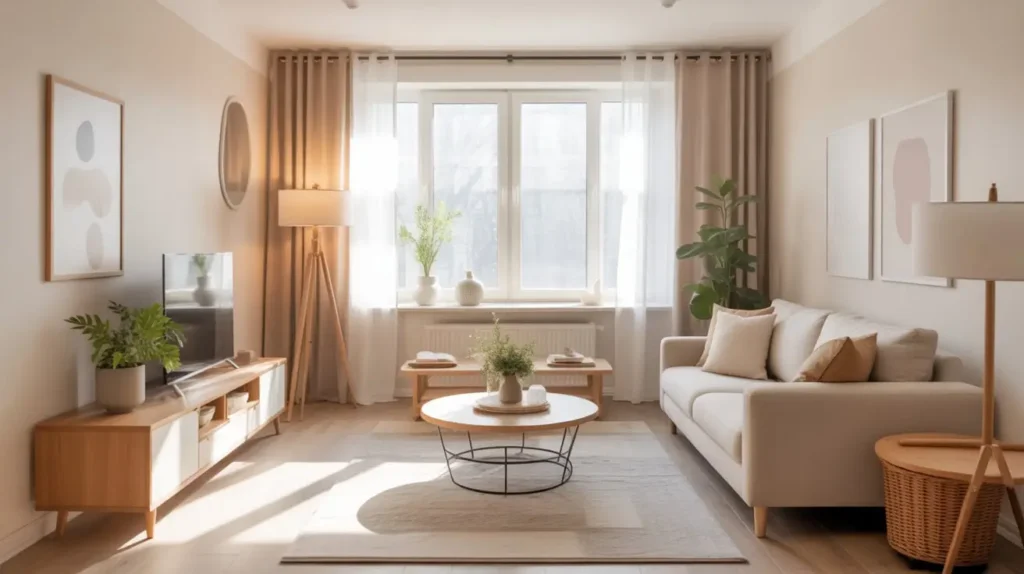
I know, I know—neutrals sound boring. But hear me out, because a minimalist neutral color palette is probably the most powerful tool for making small spaces feel larger.
Dark colors absorb light and make walls feel closer. Bright neutrals reflect light and push walls visually outward. This isn’t rocket science, but you’d be surprised how many people paint their tiny living rooms deep navy and then wonder why it feels like a cave.
The Neutral Approach That Actually Works
I’m not saying your living room needs to look like a beige void (please don’t do that). Think creamy whites, soft grays, warm taupes, and gentle greiges. These colors create a continuous flow that doesn’t chop up the space with harsh visual boundaries.
Here’s my personal formula: neutrals on the walls and large furniture, pops of color in accessories. This way, you keep that spacious, airy feeling while still having personality. Swap out throw pillows, blankets, and art seasonally if you get bored. Way easier than repainting or replacing a bright red sofa you’re already sick of. (Ask me how I know. Actually, don’t.)
Vertical Plant Wall Decor
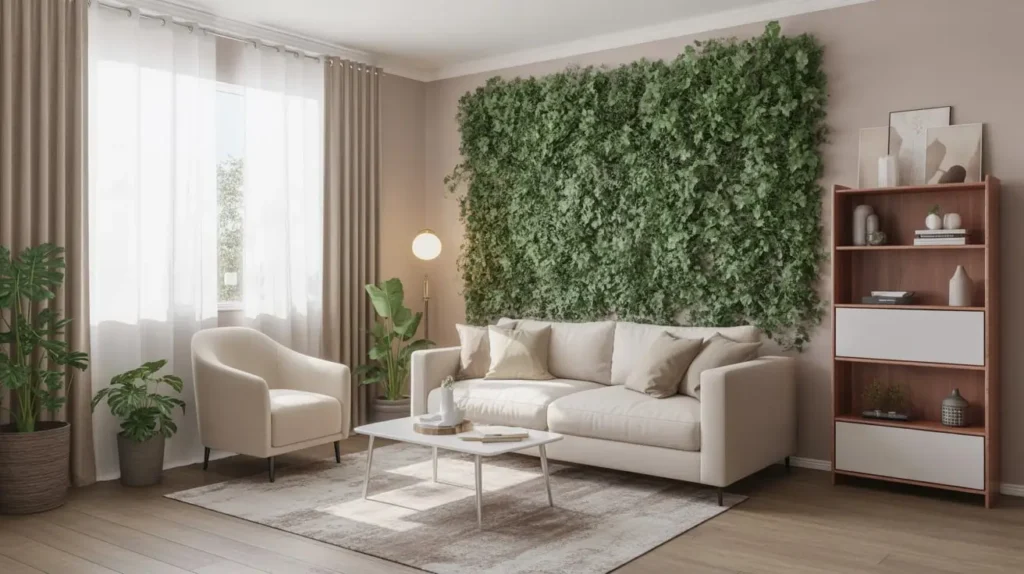
Plants make everything better—it’s basically a law of nature. But floor plants take up valuable real space that you probably don’t have. Enter: vertical plant walls that bring all that green goodness without sacrificing your limited floor area.
I installed a vertical planter system on one wall, and it completely transformed the vibe of my living room. Suddenly, I had this lush, living focal point that drew the eye upward (more on why that matters in a second) without cluttering the floor.
Going Vertical with Greenery
Vertical gardens work by utilizing wall space that typically sits empty anyway. You can buy ready-made systems with built-in irrigation, or go the DIY route with mounted planters at different heights. Both approaches work—just depends on your commitment level and budget.
Drawing eyes upward makes ceilings feel higher, which contributes to that open, spacious sensation we’re chasing. Plus, plants improve air quality and just make you feel better. Science backs this up, so it’s basically a wellness investment. That’s what I tell myself when buying yet another pothos, anyway.
Slim Profile Console Table
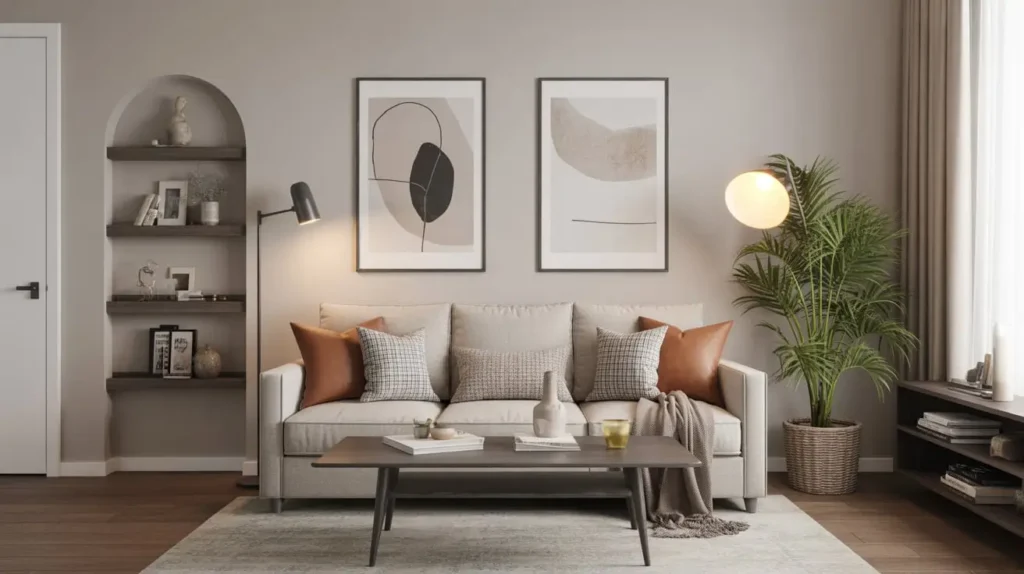
Traditional entertainment centers are space hogs. They jut out into the room, create visual weight, and generally act like they own the place. Slim profile console tables give you surface and storage space while maintaining a light footprint.
We’re talking tables that are maybe 10-12 inches deep instead of the standard 18-24 inches. That difference might not sound like much, but in a small living room? It’s everything. You gain precious floor space while still having a spot for your TV, decorative items, and storage baskets underneath.
Why Slim Wins
I replaced my chunky TV stand with a slim console, and I immediately noticed how much more open the room felt. The reduced depth means better traffic flow and less of that “furniture obstacle course” feeling we’re trying to avoid.
Look for console tables with:
- Open lower shelves instead of solid panels (creates visual lightness)
- Narrow legs that don’t visually compete for attention
- Light-colored finishes that recede rather than dominate
- Clean lines without excessive ornamentation
Mount your TV on the wall above the console rather than sitting it on top, and you can use that entire surface for decorative items or functional storage. Just a thought from someone who learned this the hard way.
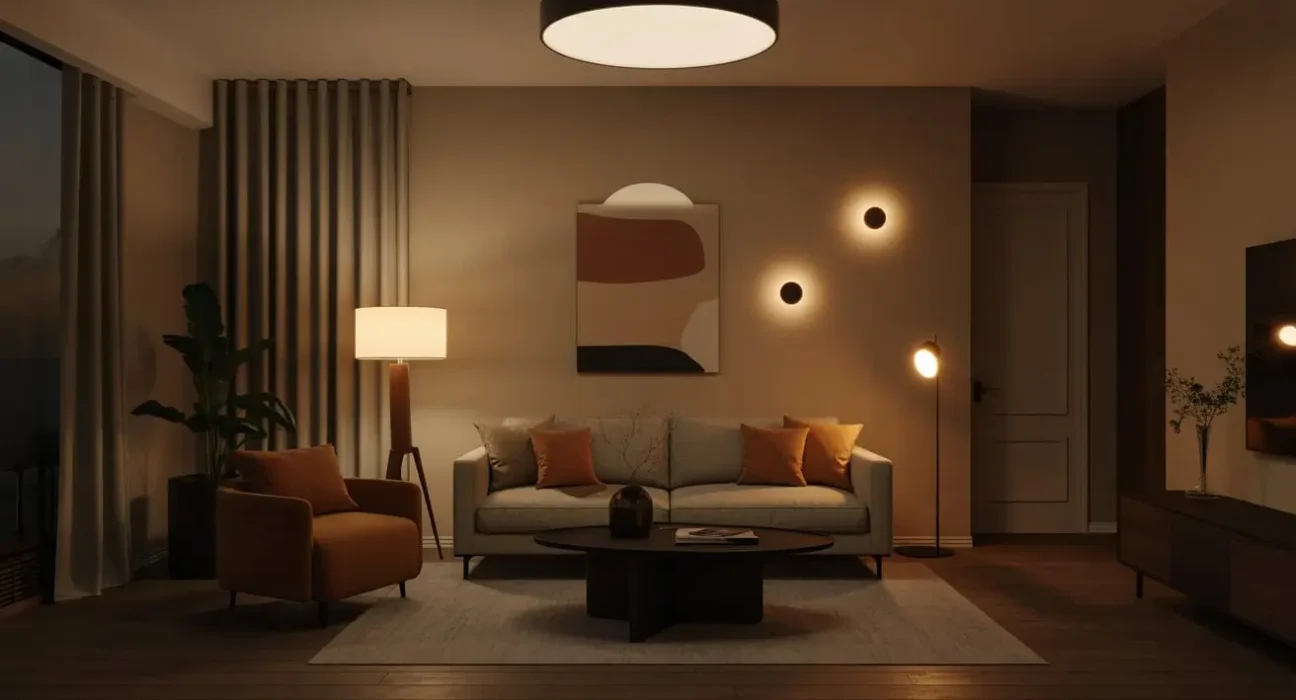
Layered Lighting for Small Rooms
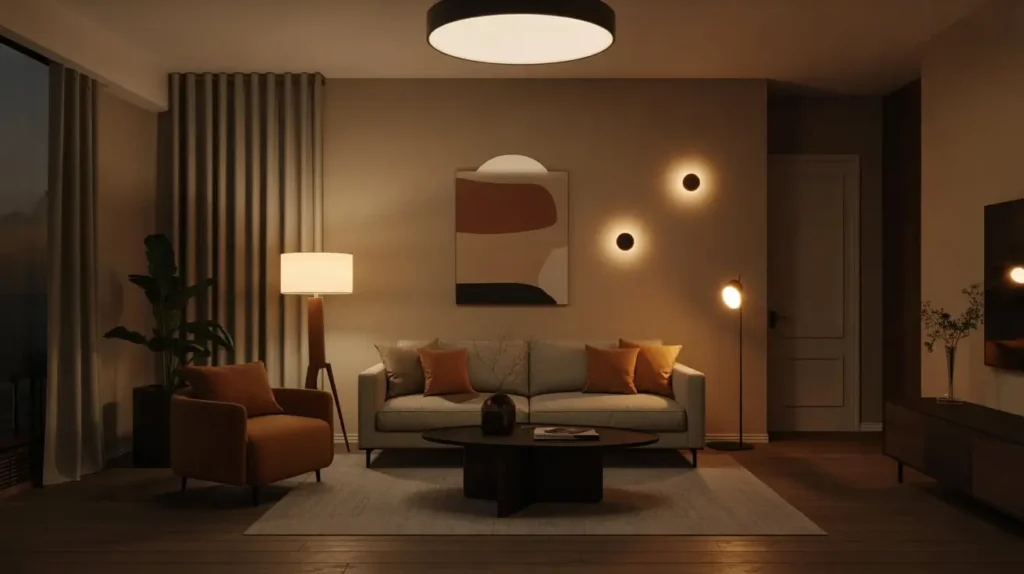
One overhead light? Amateur move. Layered lighting is what separates “meh” rooms from spaces that actually feel designed and—here’s the kicker—larger than they are.
The concept is simple: combine ambient lighting (your general overhead), task lighting (reading lamps, etc.), and accent lighting (decorative pieces that highlight features). This creates depth and dimension that a single light source just can’t achieve.
The Three-Layer Strategy
Ambient lighting sets the overall mood. Think ceiling fixtures or recessed lighting that provides general illumination. But stop there, and your room feels flat and one-dimensional.
Task lighting comes from floor lamps next to your reading chair, table lamps on side tables, or that desk lamp you use when paying bills. These create pools of light that define different zones within your living room.
Accent lighting is where the magic happens. LED strips under shelves, picture lights on artwork, or small decorative lamps create highlights and shadows that add visual complexity. Your brain perceives this layering as depth, which translates to feeling more spacious.
IMO, the best investment you can make is putting your lights on dimmer switches. Being able to adjust intensity for different times of day or activities? Game-changer. Movie night requires different lighting than working-from-home-on-the-couch mode.
Sliding Door Bookcase Divider
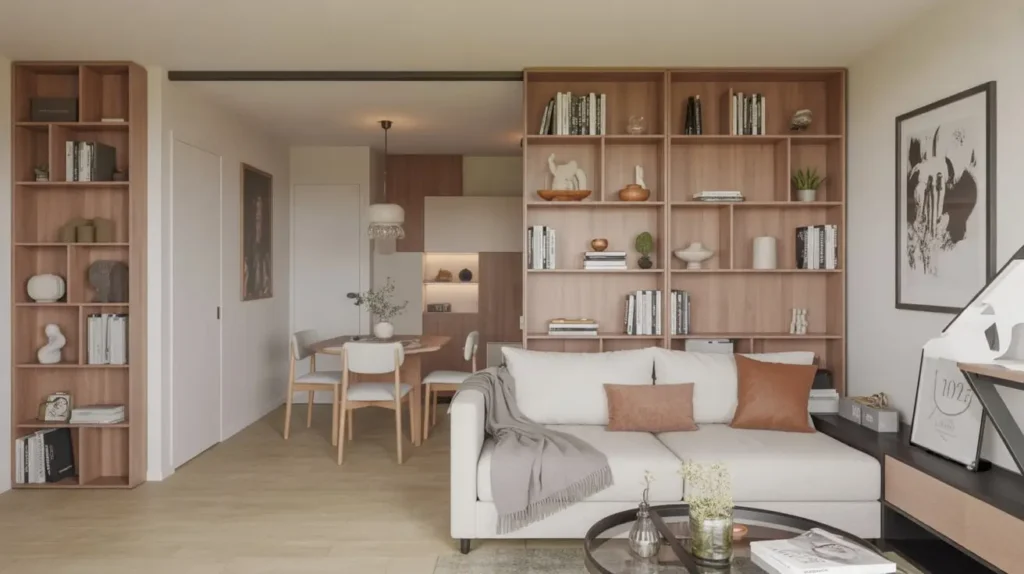
Open-concept living sounds great until you realize your living room, dining area, and entryway are all just… one big undefined blob. Sliding door bookcase dividers let you define spaces without building permanent walls that chop up your square footage.
I installed one between my living area and “dining room” (read: the corner where I eat standing up over the sink most days), and it completely changed how the space functioned. The bookcase provides storage for books, decorative items, and baskets of random stuff, while the sliding door lets me close off sections when I want visual separation.
Flexibility Meets Function
The beauty here is flexibility. Leave the sliding panel open, and you maintain that open, flowing feeling. Slide it closed, and you create two distinct zones. Hosting guests? Open. Working from home and need to hide your messy living room from Zoom calls? Closed.
Choose a bookcase divider that’s open on both sides so it looks intentional from every angle. Nobody wants to stare at the back of a bookshelf—that’s just sad. And make sure the sliding mechanism is smooth and quiet. Loud, scratchy hardware ruins the sophisticated vibe you’re going for.
Also Read: 15 Trendy Small Living Room Ideas with Minimalist Vibes
Wall-Mounted Fold-Out Desk
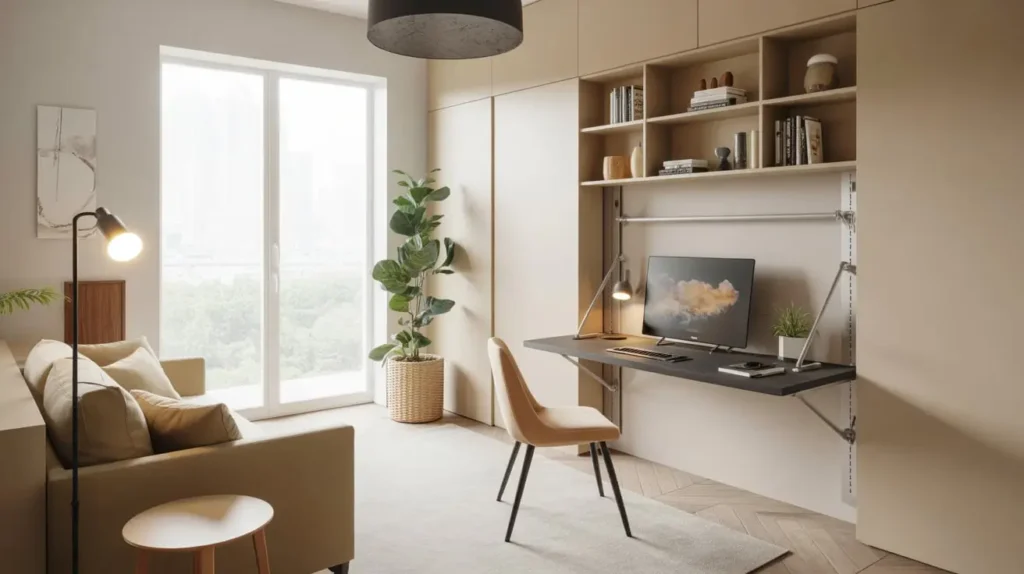
Working from home in a small apartment means your “office” is probably wherever you can balance your laptop. Wall-mounted fold-out desks give you a real workspace that completely disappears when you’re done.
This was a game-changer for me during the whole work-from-home situation. I mounted a fold-out desk to the wall, and suddenly I had a proper workspace with enough room for my laptop, a monitor, and my coffee (priorities, people). When work ends, I fold it up, and my living room goes back to being a living room instead of a office-bedroom-kitchen hybrid.
Installation and Use
These desks mount directly to the wall with sturdy brackets—you’ll want to find wall studs for this, trust me. When folded down, they provide a solid work surface. When folded up, they’re just a slim panel against the wall, maybe 3-4 inches deep.
Some designs include:
- Built-in storage for pens, notebooks, and supplies
- Chalkboard or whiteboard surfaces on the fold-up panel
- Integrated shelving that folds with the desk
- Cable management for keeping cords organized
Make sure you get one rated for the weight you’ll actually put on it. “Lightweight items only” desks won’t cut it if you’re setting up dual monitors and a printer. Learn from other people’s mistakes (definitely not mine, nope :/).
Open-Leg Furniture for Airy Feel
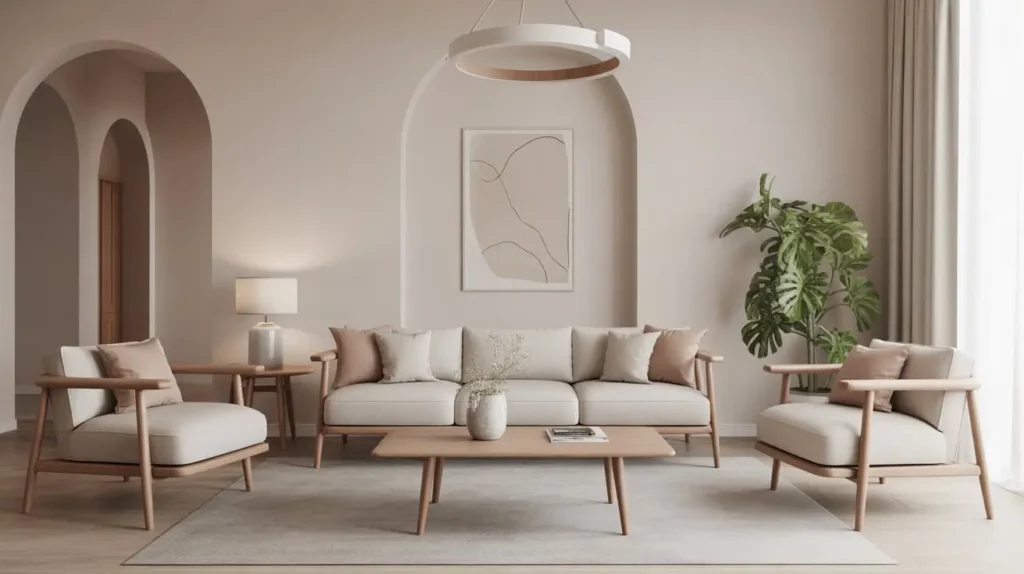
Furniture that sits directly on the floor creates visual weight and makes spaces feel heavier and more cramped. Open-leg furniture (pieces raised on visible legs) lets light and sight lines flow underneath, creating that airy, spacious feeling we’re after.
Think about it: a sofa sitting flat on the floor is a solid visual block from floor to seat height. A sofa on legs? You can see underneath it, which means your brain perceives more floor space, which reads as more room overall. It’s psychological trickery, but it works.
Choosing the Right Leg Style
I replaced my old boxy furniture with open-leg pieces, and the difference was immediate. The room felt lighter, more modern, and legitimately more spacious. Here’s what to look for:
- Legs at least 4-6 inches high for maximum visual impact
- Thin, tapered legs rather than chunky, blocky ones
- Wood or metal finishes that complement your overall design
- Consistent leg style across furniture pieces for cohesion
This applies to sofas, chairs, entertainment centers, side tables—basically everything. The more “see-through” space you create at floor level, the larger your room feels. Plus, cleaning underneath is way easier. Vacuuming without moving furniture? Revolutionary.
Curtain Zoning for Open Spaces
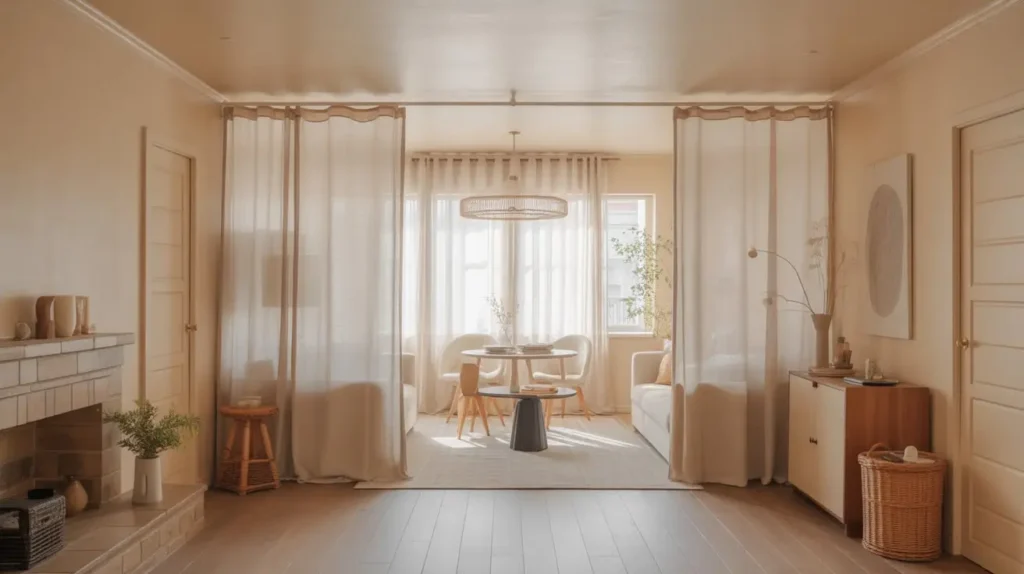
Sometimes you need to divide spaces without the commitment of actual walls or permanent dividers. Curtain zoning gives you flexible room division that you can open, close, or remove entirely based on your needs.
I used ceiling-mounted curtain tracks to create a zone between my living area and sleeping area (studio apartment life was rough, people). During the day, the curtains stay open for that flowing, open-plan vibe. At night or when I have guests, I close them for privacy and visual separation.
Making Curtains Work as Dividers
The key is choosing the right curtains and hardware. Floor-to-ceiling curtains create the most dramatic effect and make ceilings feel higher. Mount the tracks as close to the ceiling as possible to maximize this height illusion.
For curtain selection:
- Light-filtering fabrics for partial separation that maintains airiness
- Neutral colors that blend with your walls for a seamless look
- Simple patterns or solid colors rather than busy designs
- Quality hardware that glides smoothly (sticky, loud tracks ruin the effect)
This approach costs way less than installing actual walls or buying large furniture dividers, and you can change your layout whenever the mood strikes. Flexibility is clutch when you’re working with limited space.
Under-Sofa Storage Solutions
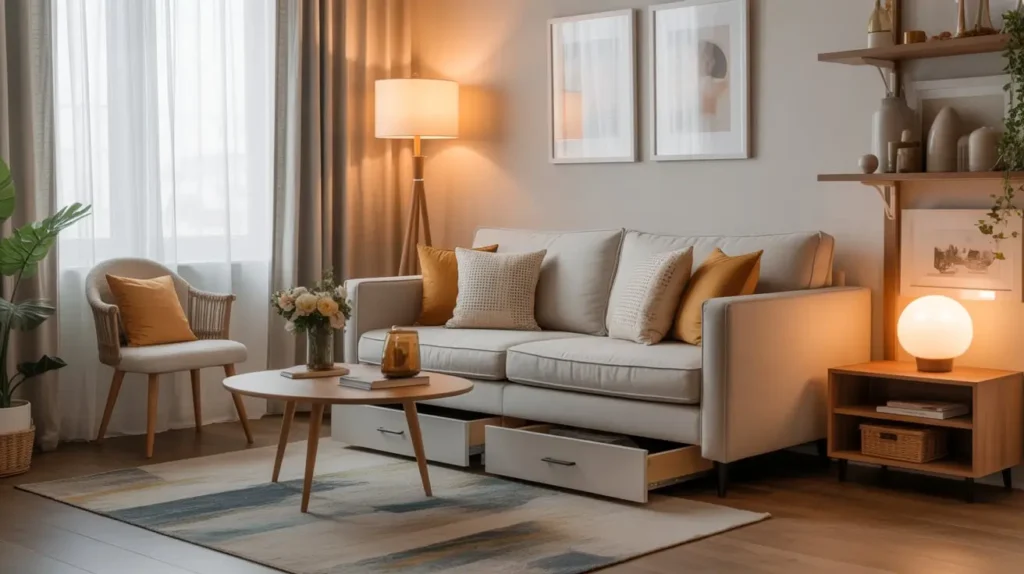
The space underneath your sofa is probably sitting there empty, mocking you and your storage problems. Under-sofa storage solutions turn that dead space into functional storage without adding any visual clutter.
Rolling storage bins designed to fit under sofas can hold everything from extra blankets and pillows to seasonal items you don’t need regular access to. I keep my winter throws under there during summer, and vice versa. Out of sight, but easily accessible when needed.
Maximizing Under-Sofa Space
First, make sure your sofa has adequate clearance—you need at least 4-5 inches for most storage solutions. Those low-profile, floor-sitting sofas we talked about avoiding earlier? This is another reason why they’re not ideal for small spaces. You lose valuable storage real estate.
Storage options include:
- Rolling bins with handles for easy access
- Vacuum-sealed bags for bulky items like comforters
- Flat storage containers designed specifically for under-furniture use
- Drawer-style units that slide out like furniture drawers
Keep items you don’t need daily in under-sofa storage. This isn’t the spot for your TV remote collection—use it for overflow storage that keeps your living spaces clutter-free. Less visible clutter equals a more spacious-feeling room, which is the entire goal here.
Pulling It All Together
Small living rooms aren’t a life sentence to cramped, uncomfortable spaces. I’ve lived it, experimented with it, and made all the mistakes so you don’t have to. These 15 ideas aren’t just theory—they’re practical solutions that actually work in real living spaces where real people deal with limited square footage.
The magic happens when you combine several of these strategies. Floating shelves with neutral colors and layered lighting? Suddenly, your room feels twice its size. Add in some open-leg furniture and a light-reflecting mirror, and you’re basically a space-maximizing wizard.
Start with the ideas that resonate most with your specific space and lifestyle. You don’t need to implement all 15 at once (that’s overwhelming and expensive). Pick two or three that address your biggest pain points, and build from there.
Your small living room has potential—it just needs some smart design choices to unlock it. Now stop scrolling through Pinterest feeling inadequate, and start actually making your space work for you. You’ve got this, and your living room is about to prove that good things really do come in small packages